The Finality of Human Error
Imagine your team's championship hopes ending on a blown call – and having absolutely no way to fix it. No replay review, no second look, no technological salvation. Just the harsh reality that one person's split-second judgment, right or wrong, has decided your fate. For most of sports history, this wasn't a nightmare scenario – it was simply how games worked.
In today's world of frame-by-frame analysis and multiple camera angles, it's almost impossible to comprehend how final those moments used to be. When officials made mistakes, and they certainly did, athletes and fans had to live with the consequences no matter how obviously wrong the call might have been.
When Cameras Couldn't Save You
The technology existed to capture these moments – television cameras were rolling, photographers were clicking away. But the idea of using that footage to correct calls in real-time was pure fantasy. Replays were for entertainment, not officiating. Fans at home might see clear evidence that a call was wrong, but that knowledge was powerless to change anything.
Consider the 1972 Olympic basketball final between the United States and Soviet Union. With seconds remaining and the U.S. leading by one point, officials reset the game clock not once, but twice, eventually allowing the Soviets to score a controversial winning basket. Television footage clearly showed the irregularities, but replay review didn't exist. The Americans refused their silver medals and the controversy rages to this day.
In the NFL, the "Immaculate Reception" in 1972 remains one of the most debated plays in football history. Did Franco Harris catch the ball legally, or did it bounce off another Steelers player first? Cameras caught every angle, but officials had to make their call based on what they saw in real-time from field level. The touchdown stood, Pittsburgh won, and fans have been arguing about it ever since.
The Human Element
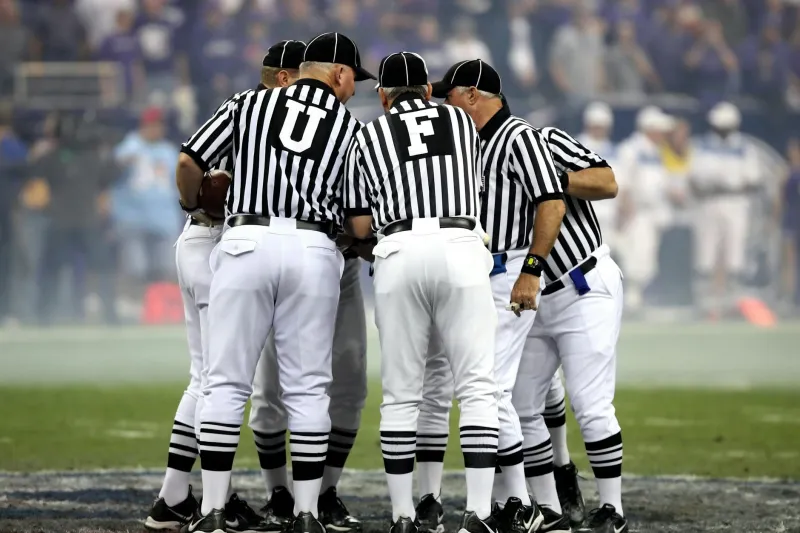
Referees and umpires operated under crushing pressure that's hard to imagine today. Every call was final, every decision permanent. There was no safety net, no opportunity for correction. Officials knew that a single mistake could decide championships, end careers, or spark riots.
Baseball umpires called balls and strikes, safe and out, fair and foul – all without the benefit of multiple camera angles or computer assistance. Home plate umpires crouched behind catchers, peering through masks and around bodies to call pitches traveling 90+ miles per hour. The strike zone was whatever that particular umpire said it was, and there was no appeal.
In basketball, referees had to track ten players moving at full speed while making split-second decisions about charges, blocks, travels, and fouls. The three-point line didn't even exist in college basketball until 1986, but even basic calls like whether a shot was released before the buzzer relied entirely on human perception and timing.
Living With Injustice
The psychological impact on athletes was profound. Players knew that no matter how well they performed, their efforts could be undone by an official's mistake with no recourse. The phrase "that's sports" took on a much heavier meaning when bad calls were simply part of the game's cruel reality.
Coaches developed elaborate strategies around managing officials, knowing that building relationships with referees might be the only protection against game-changing mistakes. The art of "working the refs" became crucial because once officials made up their minds, there was no changing them.
Fans experienced a different kind of helplessness too. Watching replays at home that clearly showed missed calls created a unique frustration – you could see the truth, but it didn't matter. Television broadcasts would show obvious errors over and over, but the scoreboard remained unchanged.
The Slow Revolution
Change came gradually and with significant resistance. The first instant replay system in the NFL debuted in 1986, but it was clunky and controversial. Officials reviewed calls using a small monitor on the sideline, often taking several minutes to reach decisions that satisfied no one. The system was abandoned after the 1991 season, deemed too disruptive to the game's flow.
Tennis introduced electronic line-calling assistance in the 1970s, but it took decades before players could challenge calls. The modern challenge system didn't arrive until 2006, giving players a limited number of opportunities to appeal line calls to computer analysis.
Baseball, perhaps the most tradition-bound sport, held out the longest. Instant replay for home run calls wasn't introduced until 2008, and comprehensive replay review didn't arrive until 2014. For over a century, baseball operated on the principle that umpires' calls, right or wrong, were final.
The New Reality
Today's athletes compete in a different universe. Controversial calls can be reviewed from dozens of angles in ultra-slow motion. Computer systems track whether tennis balls are in or out to the millimeter. Goal-line technology in soccer can determine whether a ball crossed the line even when human eyes can't tell.
The NFL's current replay system allows officials to review virtually any call, often taking several minutes to examine frame-by-frame footage from multiple cameras. What once would have been accepted as an unfortunate but unchangeable mistake can now be corrected with surgical precision.
The Price of Perfection
This technological revolution has brought its own challenges. Games now include lengthy replay delays that disrupt momentum and test fans' patience. The human element that once defined sports officiating has been partially replaced by committee decisions and video analysis.
Some argue that the constant second-guessing of officials has made sports less spontaneous, more clinical. The immediate finality that once made every call dramatic has been replaced by a more methodical, but arguably less exciting, pursuit of accuracy.
The Lost Art of Acceptance
Perhaps most significantly, we've lost the ability to accept that sports, like life, sometimes aren't fair. Earlier generations of athletes and fans understood that bad calls were part of the game's fabric, not glitches to be eliminated. There was a certain dignity in accepting defeat gracefully, even when victory had been stolen by an official's mistake.
Today's athletes have grown up expecting technological salvation from human error. The idea of a championship being decided by a blown call with no recourse seems almost barbaric to modern competitors who've never known a world without replay review.
Looking back, it's remarkable that sports maintained their integrity and popularity for so long without these technological safeguards. Athletes competed knowing that justice wasn't guaranteed, fans accepted that their teams might lose unfairly, and officials carried the enormous burden of making perfect decisions in impossible circumstances. It was a different kind of sports world – messier, more human, and perhaps more honest about the role that chance and imperfection play in competition.