Picture this: It's the 1979 AFC Championship game, and Pittsburgh's Franco Harris appears to fumble at the goal line. The referee, standing 15 yards away with players blocking his view, signals touchdown. No cameras to consult. No booth review. No challenge flag. His call stands, and the Steelers advance to the Super Bowl based on one man's best guess in real time.
This was reality for nearly a century of American sports. From baseball's first professional leagues in the 1870s through the NFL's adoption of instant replay in 1986, officials operated in a world where their initial judgment was absolutely final. No second chances, no technological assistance, just human eyes trying to track superhuman athletes moving at impossible speeds.
The Weight of Being Wrong
Referees in this era carried an enormous psychological burden. They knew that one missed call could decide a championship, end a perfect season, or cost a team millions in playoff revenue. Yet they had no safety net beyond their own training and instincts.
Consider the 1985 World Series, when umpire Don Denkinger called Kansas City's Jorge Orta safe at first base despite clear photographic evidence that he was out. That single call shifted momentum in Game 6, helping the Royals force a decisive Game 7 they would win. Denkinger received death threats for months afterward, all because he made a human mistake that couldn't be corrected.
Baseball umpires developed almost supernatural confidence to survive this pressure. They had to sell every call with absolute conviction, even when privately uncertain. The famous umpire Earl Weaver once said officials needed "rabbit ears and rhinoceros skin" – hearing everything while letting criticism bounce off.
When Speed Overwhelmed Human Perception
As athletes became faster and stronger through the 1960s and 70s, the gap between human perception and sporting reality widened dramatically. NFL players who once ran 40-yard dashes in 5.0 seconds were suddenly clocking 4.3s. Basketball players jumped higher. Hockey pucks flew faster.
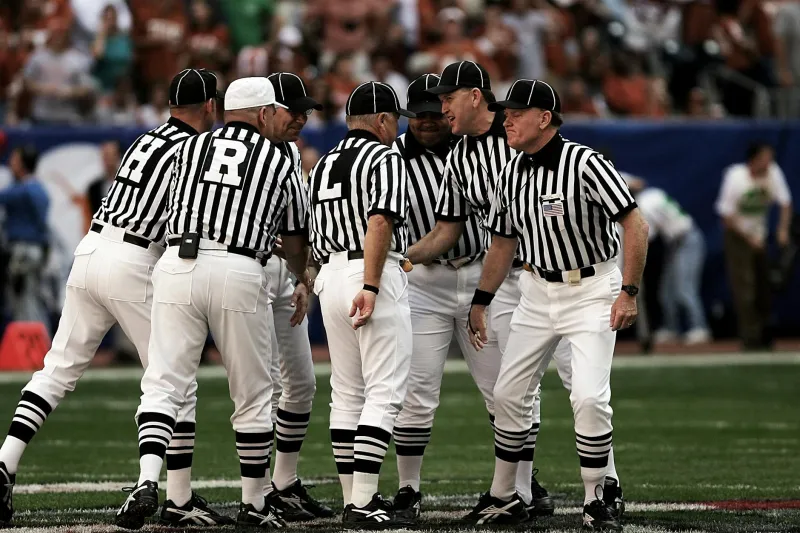
Yet referees were still expected to track every movement with naked eyes from fixed positions on the field. They couldn't pause, rewind, or zoom in. They saw each play exactly once, often from poor angles, frequently with their view blocked by the very athletes they were trying to monitor.
Football presented the biggest challenges. Officials had to determine if a receiver's foot touched the sideline while simultaneously watching for defensive pass interference, all while 22 players moved at full speed around them. The margin for error was microscopic, but the consequences were enormous.
The Art of Selling Uncertainty
Without replay to back them up, referees developed elaborate rituals to project authority. They would pause dramatically before making crucial calls, selling confidence they might not actually feel. The theatrical arm gestures and decisive whistles weren't just communication – they were psychological armor.
Some officials became masters of controlled ambiguity. When uncertain about a close play, they'd position themselves to see the reaction of players and coaches, using those cues to inform their decision. If the defense celebrated while the offense looked dejected, that told a story about what really happened.
Baseball umpires famously "ring up" strikeout victims with exaggerated punching motions, partly because the dramatic gesture helped convince everyone – including themselves – that they'd made the right call.
The Revolution Arrives
Instant replay entered professional sports gradually, with mixed results. The NFL first tried it in 1986, abandoned it in 1992 due to game delays, then brought it back permanently in 1999. Baseball resisted until 2008, and even then only for home run calls.
The early systems were clunky and limited. Coaches received a finite number of challenges. Reviews took forever. Some calls remained "unreviewable" due to technology limitations or league politics. But the fundamental shift had occurred – human judgment was no longer the final word.
What We Lost and Gained
Modern replay systems have virtually eliminated the obviously blown call that decides major games. Fans rarely leave stadiums feeling robbed by incompetent officiating. The "human element" that once drove passionate debates has been largely sanitized away.
But something intangible disappeared too. The referee's absolute authority created a different relationship between officials and the game. They weren't just rule enforcers but the final arbiters of sporting truth. Their mistakes were part of the story, woven into the fabric of memorable games.
Today's officials operate more like technicians, managing replay reviews and consulting rule books on tablets. They're more accurate but less central to the drama. The referee who made the wrong call and had to live with it forever has become an endangered species.
The Human Game We Left Behind
Before replay, every controversial call spawned decades of debate. Fans would argue about what "really" happened, armed only with grainy newspaper photos and conflicting eyewitness accounts. These disputes became part of sports mythology, passed down through generations of supporters.
Now we know exactly what happened on every play, frame by frame. The mystery is gone, replaced by pixel-perfect certainty. We've traded the flawed humanity of sports for technological precision, and we're probably better for it. But something unmistakably human was lost when the referee stopped being the only camera in the building.