Twenty-Four Exposures and You Made Them Count: What We Lost When Photos Became Free
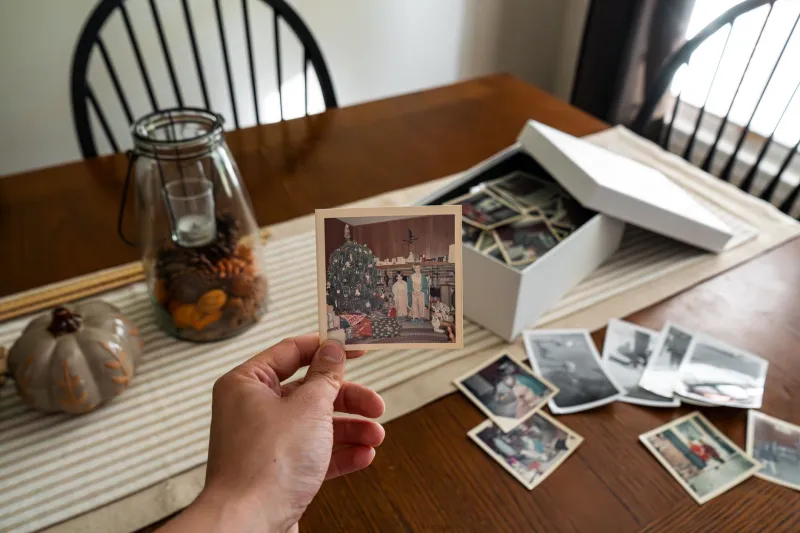
Somewhere in a closet, a garage, or a storage unit, there is probably a shoebox. Inside it: loose prints with white borders, some slightly blurry, some with a thumb across the corner, some overexposed to the point of ghost. A birthday cake with too many candles. A first car. A vacation where everyone is squinting into the sun.
That shoebox is a time machine built from scarcity. Every photo in it survived a selection process — someone chose to press the shutter, paid to develop the film, and kept the print. The ones that made it into the box mattered enough to hold onto.
Most of us don't have shoeboxes anymore. We have phones with forty thousand images and no real system for any of them.
The Economics of Remembering
Film photography was expensive in ways that are genuinely hard to appreciate now. A roll of 35mm film gave you twenty-four or thirty-six exposures. You bought the roll, you loaded it, and then you spent it carefully — because once it was gone, it was gone. When you finished the roll, you took it to a drugstore or a photo lab, paid for developing and printing, and waited. One hour if you were lucky. A week if you weren't.
The average American family in, say, 1985 probably took somewhere between one hundred and two hundred photos per year. Holidays, birthdays, vacations, maybe a school play. The camera came out for occasions. It lived in a drawer the rest of the time.
This wasn't a limitation people resented — it was just the reality of photography. The cost and the waiting built in a kind of intentionality. When you raised a camera, you thought about it. You waited for the right moment because you only had so many moments available.
And when the prints came back, the experience of seeing them for the first time — genuinely not knowing what you'd captured — was its own small ritual. A reunion with a moment you'd already half-forgotten.
The Digital Rupture
Digital cameras started appearing in consumer price ranges in the late 1990s, but the real break came with the smartphone. The iPhone launched in 2007 with a two-megapixel camera that seems laughable now. By 2012, the iPhone 4S was good enough that it became one of the most-used cameras on Flickr. By 2016, the camera had become arguably the primary reason most people bought a phone.
The constraint evaporated overnight. Suddenly there was no roll to finish, no developing cost, no waiting. You could take a hundred photos of the same moment, review them immediately, delete the ones you didn't like, and start again. The feedback loop collapsed from weeks to seconds.
The numbers tell a story that's almost hard to process. In 1999, roughly 80 billion photographs were taken worldwide. In 2023, the estimate was approximately 1.8 trillion. That's not a trend. That's a different civilization.
What We Gained — and It's Real
It would be easy to be purely nostalgic here, but that would be dishonest. Digital photography has democratized something that used to require money, access, and skill. A teenager in rural Arkansas with a smartphone has photographic capabilities that a professional studio couldn't match in 1975. Events that used to go unrecorded — a Tuesday afternoon, a random conversation, a meal that turned out beautiful — can now be preserved without anyone having to decide in advance that they're worth preserving.
For families, the accessibility is genuinely meaningful. Parents today have documentation of their children's childhoods that earlier generations simply couldn't have. The kid who grew up in the 1970s might have fifty photos from their entire childhood. The kid growing up today might have fifty photos from last weekend.
And the sharing dimension changed everything about how images function socially. A photo taken in 2024 can be seen by everyone who matters to you within thirty seconds. The shoebox was private by necessity. The phone is public by default.
The Attention We Stopped Paying
But something shifted in the relationship between the moment and the record of it. When photos were expensive, the camera's presence signaled importance. You brought it out because something was worth documenting. The act of photographing was itself a kind of declaration: this matters.
Now the camera is always present, which means nothing is specially designated. We photograph meals we'll forget, sunsets we barely looked at, receipts we might need someday. The abundance has made curation almost impossible. Most people's photo libraries are essentially unmanaged archives — thousands of images that will never be organized, never be printed, never be put in anything resembling a shoebox.
There's also a growing body of research suggesting that the act of photographing something can actually reduce how well you remember it. The "photo-taking impairment effect" — documented by cognitive psychologist Linda Henkel at Fairfield University — found that participants who photographed objects in a museum remembered fewer details about them than participants who simply observed. The camera becomes a cognitive outsourcing device. The phone will remember it, so you don't have to.
The Shoebox Was a Filter
When your grandmother's shoebox eventually gets opened, every photo in it was chosen. Someone took the picture, waited for it, paid for it, and decided it was worth keeping. The bad ones got thrown away. What survived was a curated version of a life — imperfect and incomplete, but intentional.
Most of us will leave behind hard drives full of thousands of nearly identical images with no organizing principle at all. That's not necessarily tragic. But it is different in ways worth understanding.
The scarcity wasn't just a limitation. It was also a lens — one that forced people to decide what mattered before they picked up the camera. We traded that lens for infinite storage, and the trade made a lot of sense.
It just changed what memory looks like.