One Night Only: When Going to the Movies Was Actually a Big Deal
Picture a Friday night in a small Iowa town in 1954. The grain elevator is dark. The hardware store is closed. But two blocks down Main Street, the marquee is lit up, and there's a line stretching past the barbershop. A new picture has arrived. It may only be here for the weekend. If you miss it, you might not get another chance for months — maybe ever.
That is not a scene from a foreign country. That is how most of America experienced movies for the better part of the twentieth century. And it shaped a relationship with film — and with shared culture — that we've almost completely forgotten.
The Geography of Getting to See Something
In the golden age of Hollywood, films didn't release everywhere at once. Distribution worked in tiers. A major studio picture would open first in large cities — New York, Los Angeles, Chicago — often in a single prestigious theater, sometimes for weeks or months before moving on. It would then cascade outward through progressively smaller markets, arriving in mid-sized cities, then small towns, sometimes a year or more after its initial release.
For rural Americans, this wasn't an abstraction. It meant that a film your cousin in Chicago had seen last spring might not reach your county seat until fall. You might read about it in a magazine, hear people talk about it on the radio, see a poster at the feed store — and then wait. The anticipation wasn't a bug. It was the whole experience.
Some towns were too small to support a permanent theater at all. That's where traveling picture shows came in — projection equipment loaded into a truck, a screen set up in a community hall or a barn, an operator who moved a circuit of small towns on a rotating schedule. You might get movies four or five times a year. Each one was an occasion.
The Drive-In and the Democracy of the Parking Lot
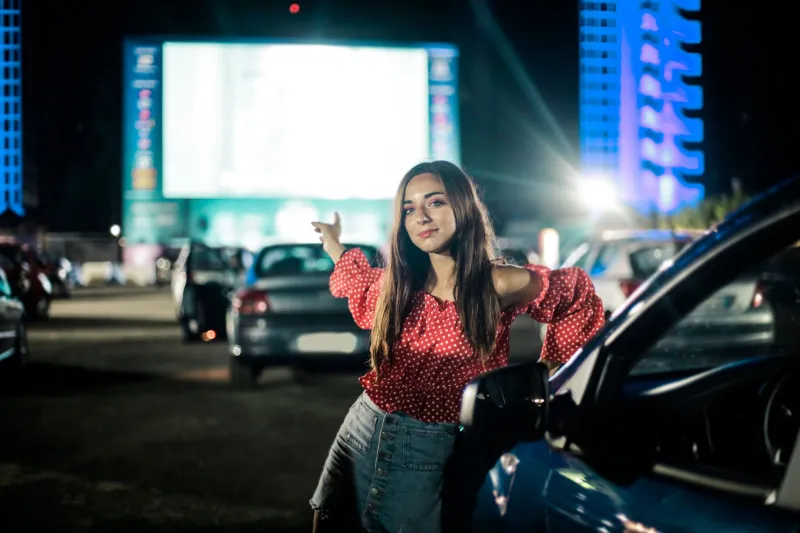
Few institutions capture mid-century American movie culture better than the drive-in theater. At its peak in the late 1950s, there were more than 4,000 drive-ins operating across the United States. They were everywhere — outside cities, along highways, in the flat farmland of the Midwest and the humid edges of Southern towns.
The drive-in was democratic in a way that indoor theaters often weren't. Families with young kids could come without worrying about noise. Teenagers had somewhere to go on a Friday night that their parents considered acceptable. You could bring your own snacks, sit in your own car, and watch two features back to back for a dollar. The movie was almost secondary to the event of being there.
And the movies themselves carried cultural weight precisely because everyone in a given community experienced them together. If a film came to your town, you saw it — or you were the person who hadn't seen it. There was no algorithm serving you a personalized alternative. The same picture played for everyone in the parking lot, and you talked about it at school on Monday.
The Multiplex Changed Everything (And Then Streaming Changed It Again)
The multiplex era, which took hold in the 1970s and expanded aggressively through the 1980s and 1990s, was supposed to make movies more accessible. And it did. Suburban shopping malls anchored by 10- and 12-screen theaters meant that a wider variety of films could play simultaneously, with more showtimes, in more communities.
But something was also lost in the expansion. When a film is one of twelve things playing at a mall theater, it stops being an event and starts being a commodity. The scarcity that had made a new picture feel significant evaporated. You could see it this weekend or next weekend or the weekend after that. You could wait for it on cable. Eventually, you could rent it at Blockbuster. The urgency drained out.
Streaming finished the job. Today, a major film might be available to watch at home within weeks of its theatrical release. Smaller films skip theaters entirely. The idea of waiting for a movie — of it not being available to you until it decided to arrive — is essentially foreign to anyone under 30.
What Scarcity Actually Did
It's easy to romanticize the inconvenience. Nobody seriously wants to go back to a world where you might miss a film entirely because it left your town before you could get to it. Access is better now. Full stop.
But scarcity did something that abundance can't replicate: it created shared cultural moments. When the same film played in every small town in America over the course of a summer, it became a common reference point. People who'd never meet each other had seen the same thing, felt the same things, laughed at the same scenes. Movies built a kind of connective tissue in the culture.
The conversation that followed a film — at the diner, at church, at school — had a different quality when everyone had seen the same thing at roughly the same time. There was no option to skip it, no version where you watched it three months later and avoided spoilers. The shared experience was the point.
The Marquee Is Still On
America still has movie theaters, of course. Some of them are genuinely wonderful — restored single-screen houses in small towns that have survived every technological disruption through sheer community will. The people who run them and the people who attend them understand something that streaming can't provide: the experience of sitting in the dark with strangers, waiting for the same thing to begin.
That's the part that was never really about the film. It was about being there. Together. With nowhere else to be and nothing else to do but watch.
For one night, at least, everyone in town was in the same place at the same time. Were we ever here? For a few hours on a Friday night in 1954, we really were.