The Number Everyone Knew and Nobody Hid: When Your Paycheck Wasn't a Secret
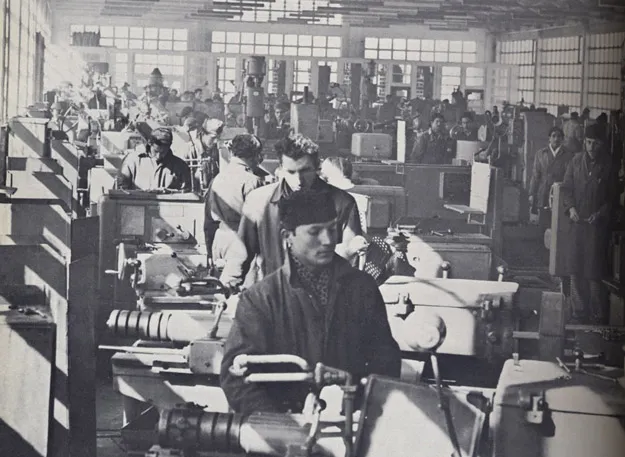
Photo: Unknown authorUnknown author, Public domain, via Wikimedia Commons
If you grew up in a certain kind of American neighborhood — a union town, a company town, a place where most people worked the same shift at the same plant — there's a good chance your parents knew exactly what the family next door was bringing home. Not because anyone was prying. Just because it wasn't a secret.
The foreman made this much. The floor workers made that much. Everyone on the line with five years in got a certain rate, and everyone knew it because the rate was the rate. There was no mystery, no awkward deflection, no carefully worded non-answer when someone asked.
Somewhere between that world and this one, pay became the thing you never discuss. And that shift cost American workers more than most of them realize.
When Wages Were Just Information
For the first half of the twentieth century, wage transparency was less a policy than a fact of life in many American industries. Union contracts made pay scales public by design — the whole point of collective bargaining was that everyone got the same rate for the same work, and secrecy would have undermined the entire structure.
Beyond unionized workplaces, small-town and neighborhood social networks functioned as informal salary databases. People talked. Not always with precision, but enough. If the hardware store owner paid his clerks more than the grocery down the street, people knew. If the new plant coming to town was offering better wages than the old one, that spread fast.
This wasn't gossip for its own sake. It was information, and it had real economic function. Workers could calibrate their expectations. They could negotiate from a position of actual knowledge. They could recognize when they were being underpaid relative to a colleague doing identical work.
How Secrecy Became the Norm
The cultural shift toward pay secrecy accelerated through the postwar decades, driven by several forces working in the same direction.
As the American economy moved away from manufacturing and toward white-collar office work, pay became more individualized. Salaries were negotiated privately rather than set by contract. Merit raises — or what employers called merit raises — introduced the idea that compensation was a personal matter between employer and employee, not a collective one.
Companies began actively discouraging salary discussions, sometimes through explicit policy, sometimes through culture. The unspoken message was clear: talking about what you made was tacky, divisive, and probably a fireable offense. Many workers assumed — incorrectly, as it turns out — that discussing their salary was actually illegal.
It isn't. The National Labor Relations Act has protected most private-sector employees' right to discuss wages with coworkers since 1935. But the cultural prohibition was so effective that the legal reality barely mattered.
What Workers Lost in the Silence
Pay secrecy didn't hurt everyone equally. It hurt women and workers of color most consistently and most severely.
When salaries are hidden, pay gaps are invisible. If a woman in an office doesn't know that the man doing the same job three desks over is earning fifteen percent more, she has no basis for a conversation, no leverage for negotiation, and no way to even identify the problem. The gap exists in plain sight — just not in her sight.
Studies have repeatedly shown that pay transparency narrows gender and racial wage gaps. The mechanism isn't complicated: when people can see the numbers, disparities become undeniable. When the numbers are hidden, disparities become deniable indefinitely.
Secrecy also shifted negotiating power decisively toward employers. A company that knows every salary in the building holds an enormous informational advantage over an individual worker who knows only their own. The worker who asks for a raise is negotiating half-blind. The employer is not.
The Slow Return of the Open Number
Something is changing again, and it's happening faster than most people expected.
Colorado, California, New York, Washington, and a growing list of other states now require employers to post salary ranges in job listings. The logic is straightforward: if you have to tell applicants what the job pays, you also have to confront the internal reality of what current employees are making. Sunlight, as they say, is a disinfectant.
Gen Z workers have pushed cultural norms hard in the same direction. Surveys consistently show that younger employees are far more willing to discuss pay openly with coworkers than their predecessors were. The old taboo is dissolving, partly out of principle and partly out of practicality — in an era where salary data is increasingly available on sites like Glassdoor and LinkedIn, the fiction of secrecy is harder to maintain anyway.
Were We Ever Here Before?
There's something worth sitting with in the arc of this story. The era of pay transparency that older generations remember wasn't some radical experiment — it was just the way things worked when workers had collective power and information flowed more freely.
The decades of secrecy in between weren't inevitable. They were constructed, deliberately and effectively, by employers who understood that information is power and that keeping workers in the dark was good for the bottom line.
The question now isn't whether pay transparency is a new idea. It's whether we're finally willing to return to something we already knew worked.
Your grandfather on the shop floor could have told you the answer. He knew exactly what everyone made, and he wasn't embarrassed about it.