The Doctor Who Watched You Grow Up: Medicine Before You Became a Patient ID Number
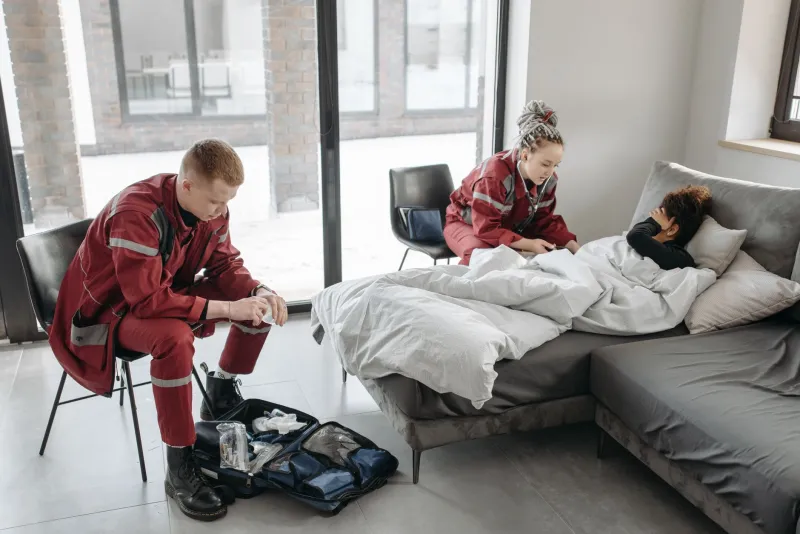
There's a version of American healthcare that most people under fifty have never experienced and probably can't fully picture. A doctor who came to your house. Who had treated your parents. Who kept notes in a manila folder he'd been adding to for fifteen years and could tell you, without looking anything up, that you always ran a low-grade fever when you were stressed. That doctor is mostly gone now. What replaced him is in many ways more capable, and in some ways profoundly less.
The House Call Was the Baseline
For the first half of the twentieth century, the house call wasn't a luxury or an anomaly. It was standard practice. When someone was sick — really sick — the doctor came to them. This wasn't sentimentality. It was practical. Patients who were ill enough to need a physician were often too ill to travel. Transportation was unreliable. And the doctor's presence in the home gave him information that a clinical setting couldn't provide: how the family lived, what the conditions were, what stress or poverty or overcrowding might be contributing to the illness.
The family physician of that era was a generalist in the truest sense. He — and it was almost always a he — handled births, childhood illnesses, broken bones, mental health crises, and end-of-life care, often for the same family across decades. The relationship was long. The knowledge was deep. When you walked into his office, he already knew most of the relevant backstory.
Handwritten notes were the record system. A doctor's files on a longtime patient might run dozens of pages — observations, patterns, hunches, family history gathered informally over years of conversation. None of it was standardized. All of it was personal.
When Medicine Got Better and More Distant at the Same Time
The postwar decades brought extraordinary advances in American medicine. Antibiotics became widely available. Vaccines reshaped childhood. Surgical techniques improved dramatically. Diagnostic tools that previous generations couldn't have imagined — X-rays, then CT scans, then MRIs — gave physicians windows into the body that transformed what was possible.
Specialization followed naturally. As medicine became more complex, the idea that one doctor could handle everything became harder to sustain. Cardiologists, neurologists, orthopedic surgeons, oncologists — each with deeper expertise in a narrower domain. The tradeoff was coordination. Your cardiologist knew your heart. Your orthopedist knew your knee. Nobody, necessarily, knew you.
The rise of employer-sponsored health insurance shifted the financial structure of medicine in ways that gradually reshaped the doctor-patient relationship. Appointments got shorter as reimbursement models changed. The economics of running a practice began to reward volume. A doctor seeing thirty patients a day cannot know each of them the way a doctor seeing twelve could.
The Digital Record That Remembers Everything Except Context
Electronic health records were supposed to fix the continuity problem. And in important ways, they have. Your records can follow you from state to state, from one health system to another. A physician seeing you for the first time can pull up your medication history, your lab results, your diagnoses going back years. That's genuinely valuable. People have been saved by information that traveled faster than they did.
But the EHR system has also introduced its own distortions. Physicians now spend a significant portion of each appointment looking at a screen rather than a patient. Studies have found that doctors spend nearly half their working hours on documentation. The notes that get entered are structured around billing codes and liability protection, not the kind of observational detail a family doctor once committed to paper because it might matter someday.
The average primary care appointment in the United States runs somewhere between fifteen and eighteen minutes. That's not enough time to build the kind of knowledge that used to accumulate over years. And increasingly, that appointment may not be with the same physician you saw last time. Turnover in primary care is high. Urgent care clinics handle what family practices once did. Telehealth has expanded access in ways that are genuinely important, but a seven-minute video call is its own kind of constraint.
What Continuity Actually Meant for Health
Research on patient outcomes consistently shows that continuity of care — seeing the same provider over time — is associated with better health results, fewer hospitalizations, and lower costs. This isn't surprising. A doctor who has known you for a decade notices when something is slightly off in ways that can't be captured in a snapshot. The deviation from your baseline is the signal. Without a baseline, there's no deviation to notice.
This is what the old family physician had that no algorithm has fully replicated: a longitudinal understanding of a specific human being. Not just what your numbers said today, but what they said last year, and the year before, and what was happening in your life each time.
Some direct primary care practices have tried to recapture this model. Patients pay a monthly membership fee — typically somewhere between $50 and $150 — for unlimited access to a physician who carries a smaller patient panel and can afford to spend more time. It's a promising model, but it's out of reach for many Americans and operates outside the insurance system in ways that create their own complications.
Were We Ever Here
The doctor who came to your house and knew three generations of your family wasn't operating in a golden age. Misdiagnosis was common. Treatments that seemed reasonable were sometimes harmful. The confidence of the mid-century family physician sometimes outran the evidence. Medicine is genuinely better now at fixing specific things.
But something real was lost when the relationship became an appointment, and the appointment became a transaction, and the transaction became a code in a system designed for billing rather than healing. The question isn't whether we can go back — we can't, and mostly shouldn't. The question is whether we can figure out how to carry the most valuable part of what that old doctor had forward into the world we've built.