He Knew Your Mother Liked Her Bread Sliced Thin: The Neighborhood Grocery Store We Traded Away
Somewhere between the postwar boom and the rise of the big-box superstore, Americans made a trade. They handed over something warm and specific — a shopping experience built around people who knew them — in exchange for something efficient and vast. More choices. Lower prices. Longer hours. Nobody's arguing those things aren't real. But the cost didn't show up on the receipt.
The Store Where Everybody Knew Your Order
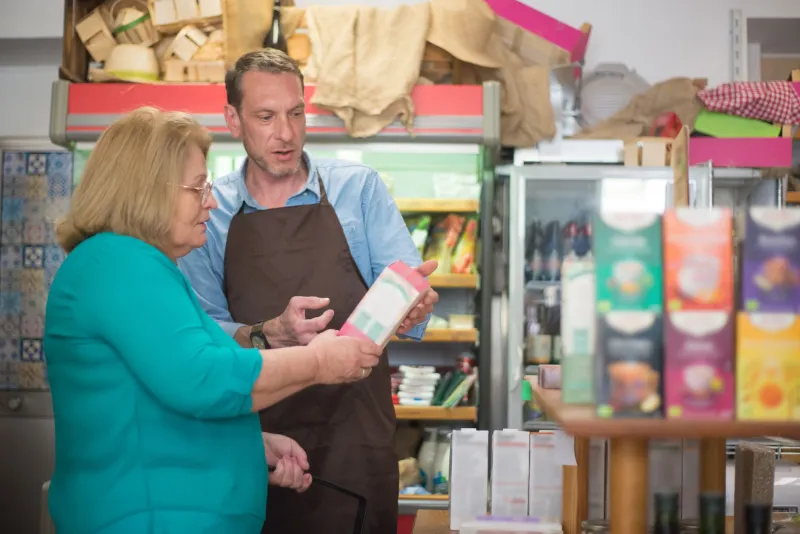
In the 1940s and 1950s, the neighborhood grocery wasn't just a place to buy food. It was a stop on the social circuit. Independent grocers operated on blocks, in neighborhoods, in small towns where the owner often lived nearby and the staff stayed for years. When you walked in, you weren't a transaction. You were Mrs. Patterson from Elm Street, and you always needed a pound of ground chuck and you'd want to know if the peaches came in yet.
Special orders were a normal part of the rhythm. If you needed something the store didn't carry, the grocer would get it — it might take a few days, but it would show up. That process required a conversation, a relationship, a degree of trust that ran in both directions. The grocer extended credit to families he knew. Customers brought loyalty in return. It wasn't charity. It was community functioning the way community is supposed to.
The physical layout reflected the philosophy. Smaller stores meant you couldn't avoid bumping into neighbors. The butcher counter required a human exchange. You asked for what you wanted. Someone went and got it. That friction — which modern retail has worked hard to eliminate — was also connection.
When Scale Changed Everything
The supermarket concept wasn't new in the postwar era, but the 1950s and 60s saw it explode across America. Self-service aisles, refrigerated cases, parking lots big enough to matter — suddenly the independent neighborhood store was competing with something that had ten times the inventory and prices it couldn't match. By the 1970s, chains were consolidating. By the 1980s, the big-box era was beginning to take shape.
The logic was hard to argue with. Why pay more at the corner store when the superstore on the highway had everything under one roof? Families on tight budgets made the rational choice. And that rational choice, multiplied across millions of households, slowly starved the neighborhood grocer of the foot traffic it needed to survive.
What disappeared alongside the small stores wasn't just nostalgia. It was institutional memory. The grocer who knew your family's health struggles, your dietary restrictions, your budget constraints — that person held a kind of knowledge that no database was designed to capture. When the store closed, that knowledge evaporated.
The Algorithm Doesn't Know You Hate Cilantro
Modern grocery retail is extraordinary by almost any objective measure. A Walmart Supercenter carries tens of thousands of items. You can order groceries online and have them on your doorstep in an hour. Apps track your purchase history and remind you when you're probably running low on something. Loyalty programs collect behavioral data and offer personalized discounts.
And yet.
The "personalization" of 2024 is a simulation of the real thing. It's pattern recognition dressed up as familiarity. The algorithm knows you bought oat milk three times last month. It doesn't know you switched because your daughter developed a dairy sensitivity and you've been quietly worried about her since the pediatrician mentioned it. It can't ask. It doesn't have time. Neither, really, does the cashier — if there even is one.
Self-checkout lanes have become the dominant model at major chains across the country. The justification is efficiency. Customers move faster. Labor costs drop. And plenty of people genuinely prefer it — no small talk required, no waiting for someone to find the produce code for leeks. But the quiet removal of human interaction from one of the most routine shared experiences in American life is worth pausing on.
What Efficiency Costs, Quietly
Research on loneliness in America has been building for years. Surgeon General advisories. Academic studies. The general sense that people are more connected digitally and less connected physically than at any point in recent memory. The erosion of "third places" — spaces outside home and work where people gather informally — is well documented.
The neighborhood grocery store was one of those places. Not in a grand or dramatic way. Nobody went there to form deep bonds. But the regularity of it, the familiarity, the small exchanges that added up over months and years — those things mattered. They were the texture of being known in a community.
There's a small countermovement worth noting. Farmers markets have grown steadily in number since the 1990s. Specialty food stores built on personal service — fishmongers, butchers, cheesemongers — have found loyal audiences in cities willing to pay for expertise and conversation. Some grocery co-ops have held on by making community membership part of the value proposition.
These aren't solutions at scale. But they're signals that something was lost, and that at least some people are willing to go looking for it.
Were We Ever Here
The grocery store where the clerk knew your name wasn't a perfect place. Prices were higher. Selection was limited. If you needed something exotic or out of season, you were probably out of luck. Progress fixed real problems.
But somewhere in the fixing, the store stopped being a place you went and became a task you completed. The difference between those two things is harder to quantify than a price comparison — which is probably why we didn't notice the trade until it was already done.