The Clock Ran Out at Six and Everyone Accepted It
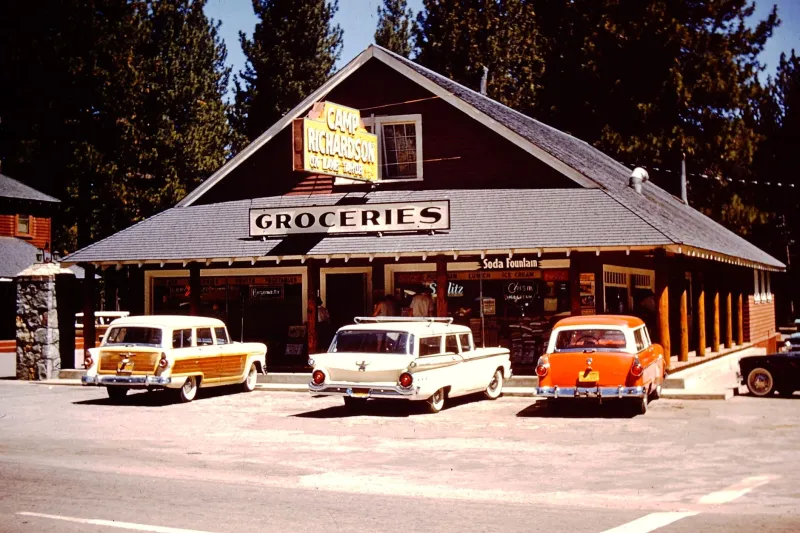
Somewhere around 9 PM on a Wednesday, you realize you're out of something. Milk, maybe. Batteries. A birthday card you forgot about. In 2025, this is barely an inconvenience. You grab your keys, or you open an app, and the problem is solved inside of thirty minutes. The store is open. It is always open. The expectation of access has become so complete that we've stopped noticing it.
But there was an America — not ancient history, just a few decades back — where the store being closed at 6 PM was not a failure of planning on your part. It was simply Tuesday. And everyone, without complaint, worked around it.
The Rhythm of the Week Had Hard Edges
Through the 1950s, 60s, and into the 1970s, American retail operated on a schedule that today would seem almost aggressively restrictive. Department stores, hardware stores, grocery stores, pharmacies — most opened around 9 AM and closed by 5 or 6 PM on weekdays. Saturday hours were often shorter. And Sunday? In most parts of the country, Sunday was simply off the table.
Blue laws — regulations that restricted commercial activity on Sundays — had roots going back to the colonial era, but they remained active and enforced in much of the United States well into the latter half of the twentieth century. Depending on where you lived, you might not be able to buy a car, purchase alcohol, shop for clothing, or even pick up a hammer at the hardware store on a Sunday. Some states restricted Sunday sales so broadly that finding anything open beyond a gas station or a diner required real effort.
This wasn't experienced as deprivation. It was just the structure of the week. You planned around it the same way you planned around the weather.
Planning Was a Life Skill, Not an App
What the old schedule demanded — and what it quietly produced — was a kind of household logistics fluency that has largely disappeared. You knew what you needed before you ran out of it, because running out at the wrong moment had real consequences. You made a list. You consolidated errands. You thought ahead.
The weekly grocery run was a genuine event in many households. Not a casual, top-off-what's-missing trip, but a considered exercise in provisioning. You bought enough because you had to. The store wasn't going to be there at 10 PM when you remembered you needed something.
Banks closed at 3 PM — sometimes earlier on Fridays. If you needed cash for the weekend, you thought about that before Friday afternoon. If you didn't, you went without, or you borrowed from a neighbor, or you found some other workaround. The financial system didn't flex for you. You flexed for it.
Doctors' offices, government agencies, hardware stores, dry cleaners — all of them operated on schedules that assumed you had some capacity to organize your own time around their availability. And somehow, most people did.
The Slow Opening of the Calendar
Things started shifting in the 1970s, and the change accelerated through the 1980s. The rise of the shopping mall created pressure to extend hours, particularly on weekends, as retailers competed for foot traffic. The Sunday blue laws fell away state by state, challenged in courts and quietly abandoned as consumer culture expanded. By the late 1980s, the 24-hour supermarket had arrived in most major American cities — a concept that would have seemed genuinely bizarre to a shopper from 1955.
Walmart's expansion in the 1990s pushed the always-open model into suburban and rural markets that had never had it. When Amazon arrived and made next-day (and eventually same-day) delivery a standard expectation, the last psychological barrier dissolved. The idea that commerce might simply be unavailable at a given moment became, for most Americans, an alien concept.
What We Got. What We Gave Away.
The gains are obvious and real. Flexibility. Freedom from the tyranny of arbitrary closing times. The ability to manage a complicated life without having to arrange it around a store's schedule. For working parents especially, extended hours weren't a luxury — they were a necessity. The old system was built around an assumption that someone in the household had daytime weekday availability, and by the 1970s and 80s, that assumption was increasingly wrong.
But there were losses, and they're worth naming.
When everything is always open, nothing feels like an occasion. The Sunday drive that ended at a closed storefront pushed families toward other activities — a park, a relative's house, a long meal at home. The hard stop of Saturday closing time created a natural boundary between the week's work and its rest. Shared closure meant shared pause. The whole neighborhood was off the clock at the same time, which produced a certain social coherence that's difficult to manufacture when everyone's schedule is entirely individualized.
There was also something clarifying about the constraint. When you can't get everything immediately, you develop a clearer sense of what you actually need. The forced pause of a closed store occasionally revealed that whatever you thought was urgent... wasn't.
The Inconvenience That Organized a Life
It sounds strange to say that a world with fewer options was in some ways a more organized world. But the closed sign at 6 PM was also a signal — to stop, to plan, to settle in. The week had a shape. The weekend had a different texture than the weekdays. Sunday was genuinely different from Saturday.
We traded that structure for access. For most purposes, it was a fair trade. But somewhere between the 24-hour pharmacy and the two-hour delivery window, the week lost its edges. Every hour started to look a lot like every other one.
And we stopped noticing — because convenience has a way of making itself invisible, right up until you try to imagine living without it.