One Small Cactus, and That Was Plenty: The Office Before You Brought Yourself to Work
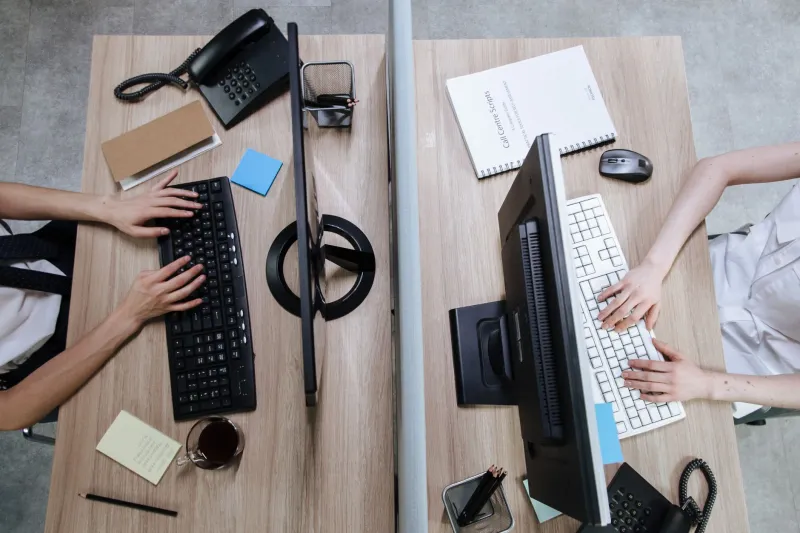
Walk through most American offices today and you'll see a lot of people. You'll also see a lot of stuff. Framed photos of kids and dogs. Succulents in ceramic pots with painted slogans. Bobbleheads. Motivational prints. Sticky notes in five colors. Tiny Bluetooth speakers. A wall calendar from a national park, even though everything is digital. The modern desk is a self-portrait in miniature, a curated snapshot of who someone is outside the building.
It wasn't always this way. For most of the twentieth century, the American workplace operated under a very different set of unspoken rules — and one of the clearest was this: the office was not about you.
The Desk That Belonged to the Job
In the postwar office culture of the 1950s and 60s, standardization was the operating principle. The gray metal desk. The matching chair. The inbox tray on the right, the outbox on the left. Fluorescent lights overhead, linoleum underfoot, and a general atmosphere that communicated, without saying so directly, that individual expression was not really the point.
This wasn't arbitrary. It reflected a genuine philosophy about what work was and what it demanded. You were there to perform a function. The company had hired a role, and you filled it. The idea that your personality, your history, your family photos, or your sense of humor had any particular relevance to the execution of that role would have struck most mid-century managers as, at best, beside the point — and at worst, a distraction.
The few personal items that did appear on desks tended to be modest to the point of near-invisibility. A framed photo of a spouse, turned slightly toward the worker rather than outward. A small plant — the cactus was popular precisely because it required almost nothing and took up almost no space. Maybe a coffee mug from home, if the workplace was relaxed enough to permit it. That was largely the extent of it.
And nobody thought this was strange. It was just what an office looked like.
The Cubicle Was Supposed to Be the Upgrade
Here's an irony worth sitting with: when the open-plan office gave way to the cubicle in the late 1960s and 1970s, it was presented as a humanizing development. Robert Propst, the designer behind the Action Office system that became the template for the cubicle, envisioned it as a space that would give workers more autonomy and better ergonomics — a break from the regimented rows of identical desks that had defined the postwar office.
What happened, of course, was that companies stripped the concept down to its cheapest form. The walls got lower, the footprint got smaller, and what was meant to be a flexible personal workspace became the gray-walled holding cell of American office satire. Dilbert didn't invent the cubicle's reputation — it just named what millions of workers already felt.
But even inside those cubicle walls, something quietly shifted. The enclosed space, however cramped, was yours in a way the open bullpen never was. Workers began, tentatively, to fill it. A calendar. A cartoon clipped from the newspaper. A child's drawing held to the fabric wall with a pushpin. The cubicle, for all its problems, accidentally gave workers a surface to project themselves onto.
The Slow Revolution of the Personal Desk
Through the 1980s and into the 1990s, the personalized workspace expanded alongside a broader cultural shift in how Americans thought about work identity. The idea that your job was simply what you did — a function you performed, separate from who you were — began to erode. Work started to become something closer to a personal statement. What you did said something about you. Where you worked said something about you. And increasingly, how your desk looked said something about you.
The tech industry accelerated this dramatically. Silicon Valley office culture, which deliberately rejected the corporate formalism of the postwar era, made the expressive workspace a symbol of creativity and innovation. If the gray metal desk represented the old, constrained, hierarchical workplace, the desk covered in action figures and whiteboards and personal artifacts represented the new, dynamic, ideas-first one. The rest of corporate America, watching the tech sector's cultural cachet grow through the 1990s and 2000s, slowly followed.
By the time the open-plan office made its controversial return in the 2010s — this time in the name of collaboration rather than efficiency — the expectation of personal expression had become so embedded that workers carried it with them even without walls to hang things on.
What the Stuff Actually Means
It would be easy to read the modern personalized desk as pure progress — workers finally allowed to show up as full human beings rather than interchangeable parts. And there's real truth in that. The mid-century office's insistence on uniformity reflected power structures and assumptions about labor that weren't exactly benign. The expectation that you'd suppress your identity at the door was, for many workers — women especially, and people of color — something more loaded than a simple aesthetic preference.
But the shift also carries complications worth examining. When your desk is a self-portrait, when your workspace is an extension of your personal brand, the boundary between you and your job gets thinner. The company that encourages you to bring your whole self to work is also, in a sense, getting more of you. The photos of your kids, the mug with the funny saying, the playlist you share with the team — these aren't just expressions of personality. They're also the texture of a life increasingly woven into professional identity in ways that can be hard to untangle.
The worker who left a blank desk in 1962 and walked out at 5 PM had, in some ways, a cleaner separation. The job ended. The person continued. The two things were related but distinct.
The Desk as Mirror
What the cactus-and-one-photo era and the gallery-wall-and-Funko-Pop era have in common is that both reflect exactly what their moment expected from workers. One said: be reliable, be consistent, be the role. The other says: be authentic, be visible, be a whole person.
Neither is simply right. But looking at how dramatically the desk has changed — from a shared, standardized surface to a deeply personal one — tells you something real about how much the relationship between Americans and their work has shifted in half a century.
We used to leave ourselves at the door. Now we build ourselves right into the furniture. And most of us, if we're honest, aren't entirely sure which version was easier to walk away from at the end of the day.