Three Days in the Car and a Dime for the Map: The Great American Drive Before the Interstate
Photo: Joe Haupt from USA, CC BY-SA 2.0, via Wikimedia Commons
Picture the scene: it's June, the kids are packed into the back of a station wagon with no seatbelts and no air conditioning, and Dad has just folded a map the size of a dinner table back into something resembling a rectangle. The destination is Chicago. The drive time, according to nobody — because nobody could tell you — is about three days.
That was America before the Interstate Highway System, and it's almost hard to believe now.
The Road Itself Was the Obstacle
When President Eisenhower signed the Federal-Aid Highway Act in 1956, the country had roughly 40,000 miles of paved highway — but almost none of it was designed for speed or continuity. What existed was a patchwork of two-lane roads stitched together by the famous numbered routes: US 40, US 30, Route 66. They were workable, but they ran straight through the middle of every town on the way.
That meant traffic lights in county seats. School zones in hamlets you'd never heard of. A drive from New York to Chicago wasn't a straight line so much as a sequence of negotiations — with local speed traps, with Sunday drivers, with a tractor taking up both lanes around Youngstown.
A determined family might cover 300 miles on a good day. Not a good hour. A good day.
The Roadside Was an Industry Built on Patience
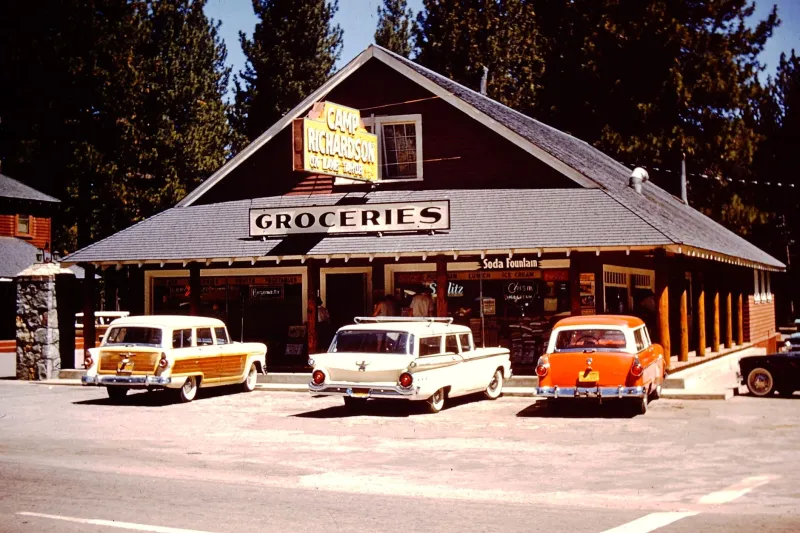
Because everyone was moving slowly and stopping often, an entire economy grew up along the shoulders of those roads. Neon-signed motor courts — the ancestors of the motel — rented rooms by the night, usually for under ten dollars, with a television that got three channels if the antenna cooperated. Diners served blue-plate specials to travelers who had no idea what a drive-thru was. Phillips 66 and Sinclair stations handed out free folding maps like business cards, because the gas station was, functionally, your GPS.
And the map mattered. Navigating in 1950 was a family activity. Someone rode shotgun with the job of calling out towns ahead, estimating distances from the little printed scale, and arguing about whether that last turn was a mistake. Getting lost wasn't a glitch in the system. It was part of the trip.
Then the Interstates Flattened Everything
The new highway system did exactly what it promised. Limited-access, four lanes, no traffic lights, no tractors. That New York-to-Chicago haul went from three days to about twelve hours. Speed limits climbed, fuel got cheaper per mile, and the family vacation radius expanded enormously. A weekend trip that once required a week of planning became casual.
But look at what the on-ramps bypassed. The motor courts with their buzzing neon? Mostly gone. The diners? Replaced by exits with the same four fast-food signs, interchangeable from Ohio to Oklahoma. The roadside America that existed because travelers had to stop — genuinely had to — became a museum piece. Whole towns that lived off highway traffic withered when the interstate routed thirty miles east.
What We Gained, What We Gave Up
There's no serious argument against the interstate. It's one of the most consequential infrastructure projects in human history, and it made the country smaller in the best sense. Freight moves. Families visit. Emergencies are drivable.
But the slow road had a texture we've completely lost. A trip used to be a story with chapters: the breakdown outside Tulsa, the waitress who drew you a shortcut on a napkin, the motel with the swimming pool shaped like a kidney. Today's version is an airport security line, a two-hour flight, and a rental car whose navigation system narrates your entire journey in a calm voice that has never been lost in its life.
The drive used to be the vacation. Now it's the thing you minimize.
We got everywhere faster. Whether we got anywhere at all is a fair question — and one worth asking the next time you're cruising at 75, watching the same exit ramp scenery blur past, with no idea what's waiting on the old two-lane road running parallel, just over the guardrail.